Welcome! The Alabama Rural Electric Association of Cooperatives (AREA) is a member-owned federation of 22 electric distribution cooperatives.
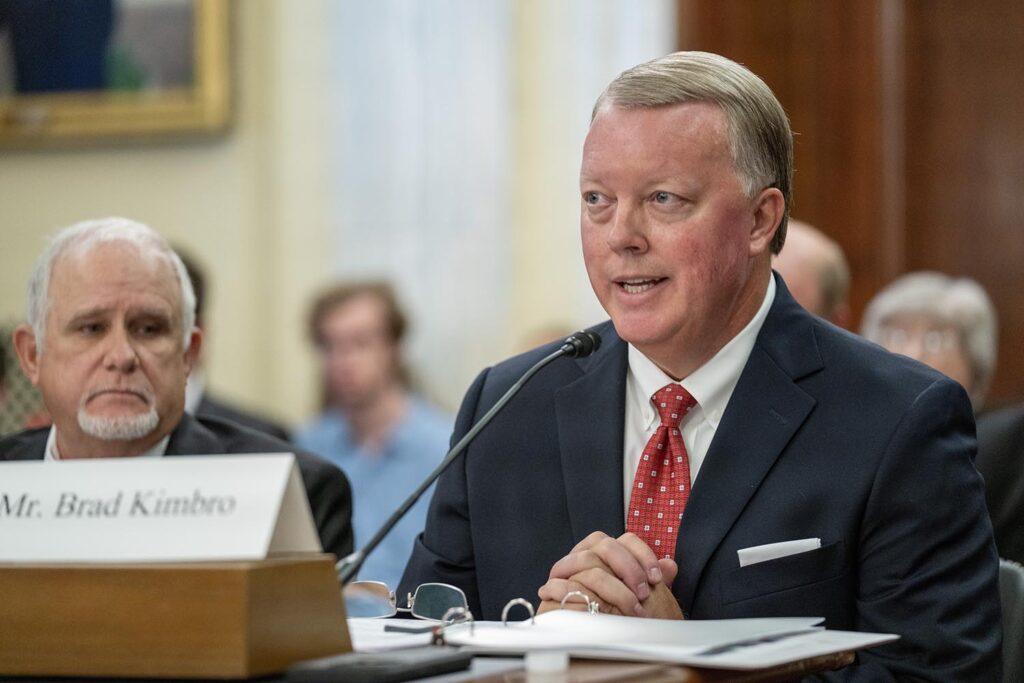
Wiregras EC CEO Brad Kimbro Testifies Before Senate Agriculture Subcommittee
Home | News | Press Releases | Wiregras EC CEO Brad Kimbro Testifies Before Senate Agriculture Subcommittee
Testimony of Brad Kimbro
Chief Executive Officer, Wiregrass Electric Cooperative
United States Senate Committee on Agriculture, Nutrition, and Forestry Subcommittee on Rural Development and Energy
“State of Rural Infrastructure: Emergency Response, Recovery, and Resilience” 328A Russell Senate Office Building
Introduction
Chairman Welch, Ranking Member Tuberville, and members of the Committee, thank you for the opportunity to testify today. On behalf of Wiregrass Electric Cooperative’s more than 18,000 consumer-members, we are grateful for the opportunity to share our perspective. We thank the Committee for their interest in issues facing rural communities and specifically their attention to the challenges rural utilities face preparing for and responding to natural disasters.
My name is Brad Kimbro and I am the Chief Executive Officer of Wiregrass Electric Cooperative (WEC). WEC is a not-for-profit distribution electric cooperative headquartered in Hartford, Alabama. Our cooperative maintains 26,356 meters in rural areas of Geneva, Henry, Houston, Dale, Coffee, and Covington counties. We service 3,205 miles of line, roughly the distance from here to the Pacific Ocean.
At our core, WEC is an electric infrastructure company. Our job is to reliably deliver affordable electricity to our consumer-members 24 hours a day, 7 days a week. We deliver electricity across our network of poles, wires, substations, and other electric infrastructure during thunderstorms, windstorms, floods, hurricanes, and other extreme weather events. When a weather event damages our infrastructure resulting in the loss of power for any of our consumer-members, our mission is to safely restore electric service in the mostly timely manner possible.
Responding to a disaster is not just about physical damage. These storms take an emotional toll on our communities and our cooperative employees. We are a co-op of around 60 employees. Our linemen perform dangerous work during times when their families’ wellbeing and financial situations are uncertain. Our ability to perform basic functions like reading meters or dealing with billing matters is upended. This impact is difficult to measure.
Rural Utilities Service (RUS) Electric Loans
The federal government has been critical to financing rural electric infrastructure since rural electrification began in the 1930s. In the early 1900s, as urban areas began to electrify, rural areas lagged behind. It became clear that the economics of the for-profit electric business did not work in high-cost, low-density areas. For decades, rural communities and policymakers were vexed by the problem of how to bring electric service to areas of the country that lacked it.
Eventually, with the passage of the Rural Electrification Act of 1936 and the establishment of the Rural Electrification Administration (REA), farmers and ranchers could pool their resources together and organize as cooperatives, then obtain REA loans to build electric infrastructure to electrify their communities.
WEC’s story is similar to many of the other roughly 900 electric cooperatives around the country. In 1939, a group of determined Wiregrass farmers joined together to form a cooperative and with help from the REA, began electrifying Wiregrass farms and homes in 1940. What was then the REA is now the Rural Utilities Service (RUS), and it is as important today as it was back then. Today, electric cooperatives use low-cost RUS electric loans to build, upgrade, and expand electric infrastructure to continue to provide affordable, reliable electric service in rural communities.
For WEC, RUS electric loans are critical to affordability and reliability. Roughly 25% of WEC consumer-members struggle to pay their electric bills. As an at-cost service provider, any costs we incur are shouldered by our membership. Low-interest loans through RUS help us keep costs low while also providing the capital necessary to invest in infrastructure to maintain reliability for our consumer-members. We use RUS electric loans for basic electric infrastructure, like poles and wires; and also to fund projects to make our systems more modern, efficient, and secure.
Disaster Financing
It is difficult to imagine life back in 1939 when WEC was founded. The families, farms, and communities of the Wiregrass region worked and raised their families without electricity. Fast forward to today when an afternoon without power is a disruptive event. A week without electricity is a once-in-a-lifetime experience of hardship and possible catastrophe. WEC’s goal is to prevent service interruptions and make them as short as possible when they occur.
Given the proximity of our service territory to the Gulf of Mexico, we occasionally are hit by hurricanes and tropical storms, along with the high winds, tornadoes, and heavy rains that accompany these weather systems. WEC is ready and prepared to respond to any outage. In 2018, Hurricane Michael came through the eastern part of our service territory resulting in extensive damage to infrastructure that needed to be repaired or rebuilt quickly. Also, there was damage not critical to getting the power back on but that needed to be addressed in the near term to maintain the safety and resiliency of our system.
Hurricane Michael ultimately resulted in around $8 million in additional costs for WEC. Our cooperative operates on thin margins, so an added cost of this size would have been a significant financial burden for our consumer-members. We are grateful that we were able to work within our RUS work plan to finance recovery efforts and ultimately secure reimbursement through the Federal Emergency Management Agency (FEMA) Public Assistance (PA) process. It is hard to overstate the importance of these programs. Without them, higher electric bills would have placed financial strain on the communities we serve, with our most vulnerable members feeling it the most.
Every disaster and every co-op is different. After some natural disasters, an electric cooperative may need to turn to a private lender or draw down an existing line of credit to finance recovery efforts because they are unable to work through their already-approved RUS work plan. The RUS electric loan program is not designed for immediate-need situations. Securing an RUS electric infrastructure loan requires time and extensive paperwork. A cooperative is responsible for submitting a work plan and going through processes that satisfy the environmental, historical preservation, and other federal requirements before approval. In some cases, obtaining RUS financing triggers new environmental requirements due to federal involvement. An electric utility focused on response and recovery after a hurricane or other severe weather event needs access to capital quickly. For this reason, obtaining a new RUS electric infrastructure loan for rebuilding is not an option.
Resiliency
In addition to my role as CEO of WEC, I serve on the Board of Trustees of PowerSouth Energy Cooperative. PowerSouth is the wholesale power provider for sixteen electric cooperatives and four municipal electric systems in Alabama and northwest Florida. A critical part of WEC’s system resiliency is ensuring that we have a reliable power supply.
RUS electric loans for generation and transmission projects play a critical role in ensuring affordability and reliability for our consumer-members, just like loans for distribution infrastructure. Each generation and transmission cooperative is responsible for making the power supply decisions for the territories they serve. They must balance the different characteristics of various generation sources, like dependability. Always available power sources like natural gas, nuclear, or hydropower are inherently different than intermittent sources like solar and wind. To ensure resiliency and reliability of systems, it is critical that RUS electric loans remain available for any of these sources a cooperative determines are best to maintain reliability and affordability for their consumer-members.
Other Federal Disaster Issues Affecting Rural Electric Cooperatives
Rural electric cooperatives are eligible for federal funding under FEMA’s Public Assistance Program and have been since the original Disaster Relief Act of 1974 was enacted (P.L. 93-288). The Disaster Relief Act, which was later re-authorized and renamed to the more commonly known Stafford Act, enabled the President to make grants to help “repair, restore, reconstruct, or replace” certain private nonprofit facilities – such as utilities – that were damaged or destroyed by a major disaster.
PA is available to an affected community only if authorized by a Presidential Declaration of emergency or major disaster. A state, tribe, or territory with an applicable Stafford Act declaration serves as the PA primary grant recipient. State, tribal, territorial, and local governments, as well as eligible nonprofit entities (such as electric co-ops), may then apply for funding as applicants. The Stafford Act authorizes FEMA to reimburse not less than 75% of the eligible costs of specific types of disaster response and recovery work undertaken by eligible applicants.
I have seen my fair share of major disasters resulting in FEMA Public Assistance while working in the utility industry, including Hurricane Charley, which wreaked havoc on Florida’s Peace River Electric Cooperative when I was there in 2004. Another, Hurricane Michael, provides a glimpse into the nature of every disaster and every co-op being different. Michael made landfall as a high-end Category 4/Category 5 storm in the Florida Panhandle in October 2018 with maximum sustained wind speed of 155 mph.
In our service territory, almost 18,000 members lost power. The storm downed about 60 miles of WEC’s electric lines, and more than 500 poles were broken or damaged. Restoring power required nine days and 225 linemen working 12–14-hour days from WEC and other Alabama cooperatives. They worked 45,000 hours, and storm recovery required $7.6 million, of which
$5,660,768.46 was eventually reimbursed approximately one year later under the Public Assistance program.
Without a doubt, securing this reimbursement and being good stewards of taxpayer dollars required hard work and attention to detail by WEC employees, who tracked and documented expenses associated with the storm. As non-profits, any costs incurred to rebuild the system are passed along to our consumer-members, so we owe it to them to fight for every eligible dollar in order to minimize potential rate impacts.
FEMA Reimbursement and Interest Eligibility
We are grateful that our reimbursement experience with Michael proceeded relatively smoothly but are aware of some applicant co-ops in Florida where the effort to secure reimbursement for the damage caused by the storm is still ongoing or only recently concluded.
I am also aware of numerous electric cooperatives in Alabama and elsewhere awaiting PA reimbursement from major storms before and after Michael. The delay in reimbursement can be caused by numerous factors given the state-federal partnership, but it is nevertheless a major issue of concern for those co-ops – particularly when they are required to take out large loans or draw down on lines of credit to cover the immediate costs of recovery to return their
communities’ and residents’ lives back to normal as quickly as possible. When electric cooperatives must borrow to cover these recovery costs until reimbursement is made, it means potentially years of accumulating interest, the cost of which is borne by the cooperative consumer-members.
FEMA has inconsistently recognized when interest paid on these loans or lines of credit can be reimbursed, and seeking the reimbursement can be a costly and complicated effort for an individual cooperative. For this reason, cooperatives encourage additional support for the FEMA Loan Interest Payment Relief Act (H.R.2672/S.1180), which would mitigate this additional burden by requiring FEMA to reimburse the cost of interest on loans taken out while the PA process is completed. Specifically, in an approach that enjoys broad bipartisan support, FEMA would reimburse cooperative electric utilities and local governments for interest expenses of loans used to fund activities for which they receive assistance under the PA program. This reimbursement would be limited to the lesser of the actual interest paid or the interest that would be paid at the prime rate.
The bright-line clarity for this interest reimbursement as provided by S.1180 would be a useful tool for Wiregrass and our fellow cooperatives to help us keep the lights on and rates affordable, and I again encourage all Senators here today to support it.
Per Capita and State Threshold Reform
I would also like to raise another FEMA Public Assistance issue affecting the recovery and resilience of rural communities, which relates to state and county thresholds established by FEMA. As part of the process to unlock federal assistance, FEMA considers different factors to evaluate a request for a major disaster declaration and recommend a course of action to the President. One key factor FEMA considers is whether costs exceed annually adjusted per capita thresholds across the county and the state or territory in need.
Despite Congressional efforts in the 2018 Disaster Relief Reform Act requiring FEMA to give “greater consideration” to severe local impacts and recent disasters when considering requests for PA, barriers remain in rural communities that struggle to meet the agency’s existing per capita benchmarks.
For example, disasters in rural areas – such as the March 2024 tornado near Cottonwood – that cause significant damage on a per capita basis to infrastructure, yet to fewer people overall, generally do not qualify for assistance under the current Public Assistance review criteria. So, unfortunately, a damaging and localized storm with high costs to local residents will not receive a federal cost share because it did not meet the Alabama statewide PA threshold, which is approximately $9.3 million in 2024. The State of Alabama Emergency Management Agency has noted that these types of undeclared disasters disproportionately affect the state’s rural and economically challenged populations.
On a related point, Wiregrass would like to associate itself with comments filed by the National Rural Electric Cooperative Association (NRECA) in March of 2021 to a proposed FEMA rule
titled “Cost of Assistance Estimates in the Disaster Declaration Process for the Public Assistance Program” that could make it even harder for small entities like ours to qualify for Public Assistance in the future by raising the state thresholds even further.
According to NRECA’s research, a wide range of stakeholders also expressed concern with the proposed rule, including Subcommittee Member Senator Grassley on behalf of the State of Iowa, the National Emergency Management Association, Vermont Emergency Management, the Vermont Association of Planning and Development Agencies, the National League of Cities, and the National Association of Counties. FEMA has yet to release a Final Rule.
Southern Pine Beetle Infestation & Vegetation Management
Finally, I would like to note a vegetation management issue electric cooperatives in the Southern Region are seeing more and more that could have significant ramifications for resiliency.
According to the U.S. Forest Service (USFS) Southern Pine Beetle Information Center, activity and damage from the southern pine beetle (SPB) is the most widespread it has been in the past 2 decades. In 2023, there were more than 3,000 southern pine beetle “spots,” and damage is significant in Alabama, Florida, Georgia, Louisiana, Mississippi, and South Carolina. More than half of the spots are on National Forest land, but there are more than 1,000 spots on state and private land as well. Populations of the native SPB can be triggered by climatic events, such as
last year’s drought in Alabama, or trees that are weakened by hurricanes or other storms.
For electric cooperatives managing their rights-of-way on a variety of lands, dealing with diseased or dead-standing trees caused by the beetle infestation is putting increased pressure on not-for-profit cooperative budgets. As the Senate Agriculture Committee continues discussions on a 2024 Farm Bill, Wiregrass and our fellow cooperatives encourage Senators to look into greater ways the U.S. Department of Agriculture and/or RUS can help manage these previously unanticipated costs associated with the SPB. For example, Agriculture Committee Member Senator Cindy Hyde-Smith has introduced the Emergency Pine Beetle Response Act and begun a conversation around a potential federal response. Cooperatives’ initial suggestion is to look at amending the bill to include our members as eligible recipients of grants and aid proposed by the Act to help ensure trees damaged by the SPB do not cause outages or other issues on the grid.
Conclusion
In closing, I would like to thank the Chair and Ranking Member for the opportunity to testify today. Nearly 900 electric cooperatives around the country routinely face extreme weather including hurricanes, snowstorms, floods, tornadoes, and other weather systems. I hope it was helpful to hear about the issues WEC has faced maintaining and rebuilding our electric infrastructure. We are grateful electric cooperatives are eligible for federal assistance programs.
To me, the then-REA and now RUS electric program are arguably the most effective economic development programs in history. Millions of rural Americans have a more prosperous life because of these programs. Rural communities would be unrecognizable today without them. Today, the RUS electric program is a critical tool for electric cooperatives building electric infrastructure, and it can provide disaster recovery financing under an existing workplan; however, it is not a nimble enough program to be a disaster response tool for a co-op in need of a new loan.
With respect to FEMA, we again appreciate the ability to participate in the Public Assistance Program and are grateful for the agency’s assistance after disaster strikes. Electric cooperatives and numerous other grant applicants are best positioned to support the communities they serve and help restore strong local economies when the grant program is administered fairly and efficiently and offers certainty.
As the Committee considers rural infrastructure issues, I look forward to working with you on our shared goal of improving rural communities. I am happy to answer any questions you may have.